What went through the wire.
Power, voltage, frequency, energy per hour. This part is certain, and it is what gets sealed into the record.
How it works
Scroll slowly. Below, a compressor starts. The curve comes from the equation for a motor, and next to it you see what hum shows on its screen at each moment.
0 ms
The draw is steady. Nothing has changed, so there is nothing to explain.
Current model: inrush of about four times running current, decaying with a 55 ms time constant, lagging the voltage. Timescale at 50 Hz.
hum recognised the kind of machine.
You gave it the name.
Three layers, kept apart
Power, voltage, frequency, energy per hour. This part is certain, and it is what gets sealed into the record.
Compressor, heating element, motor, power supply. Physics tells these apart, and the screen marks them as estimates until you confirm.
"Fridge" or "the towel rail in the bathroom". Only someone in the house knows that, so hum asks once and remembers.
Where it thinks
The hub has a screen that states where inference is running. On hum pro that is a neural processor. On a board without one it says "on the processor" and does the same job more slowly.
A two-second window around each change, including the half second before it, is what gets matched against what the house has already taught it.
Compressor, resistive, motor, switching. Those four families come out of how the current behaves, before any name is involved.
How many appliances it has seen, how many have names, and what share of the house is still unidentified.
If a start fits two machines almost equally, it offers both and the line stays an estimate.
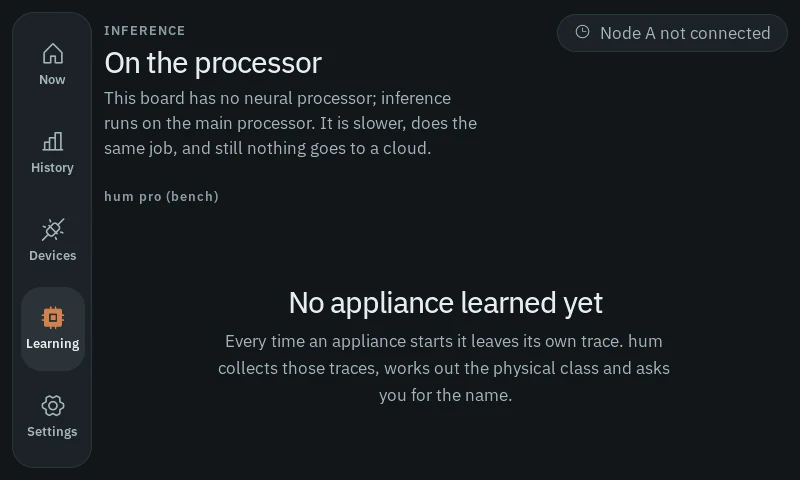
The Learning screen on a development board with no neural processor and no sensor attached. It says both.
Two models
Both models keep the same signed record. It is not an extra you pay for.
| Feature | hum | hum pro |
|---|---|---|
| Whole-house measurement, every second | Yes | Yes |
| Signed, chained hourly record | Yes | Yes |
| Appliance identification | On the processor | On a neural processor |
| "Not identified" always shown | Yes | Yes |
| Phone app, approved on the hub's screen | Yes | Yes |
| Per-appliance health: a learned baseline for each machine | No | Yes |
On hum, the health screens say "available on hum pro" and show no empty chart.
The app finds the hub by itself, and the hub asks before any phone may connect.