Home energy monitor
It knows what your house is running.
Your meter gives you one number a month. hum reads the same mains thousands of times a second and works out what is behind it: the compressor that just started, or the heater nobody switched off.
In development. A reservation costs nothing, holds no card, and takes one click to cancel.

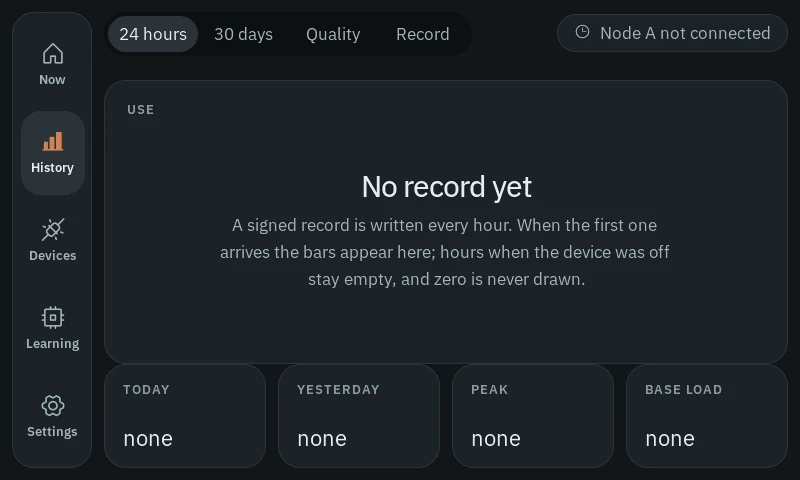
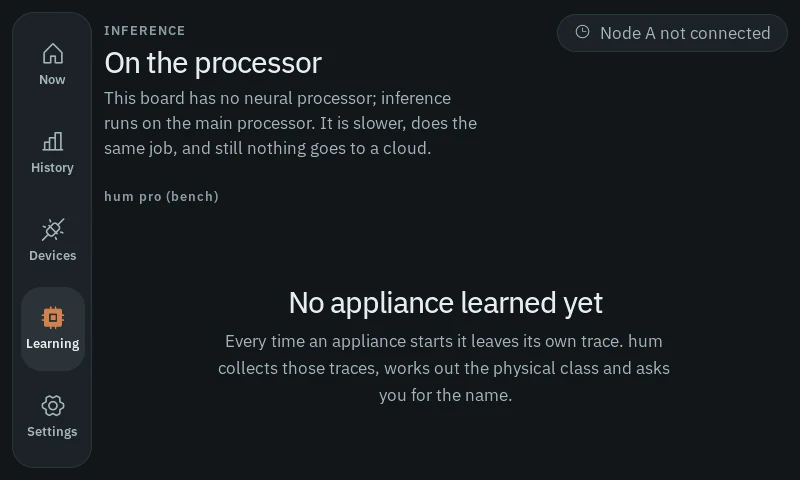
The real device software, captured from a development board. No sensor is connected yet, so the screen says "waiting for a measurement" and shows no number.
A house at rest, then something switches on. hum watches that moment. The shape of the change tells it which kind of thing just started.
Why it can tell them apart
Appliances do not start the same way.
An average hides it: 900 watts from a kettle and 900 watts from a fridge look the same. The first second does not, because it follows from how each machine is built.
Heating element
Straight in, no fuss
A kettle or an oven. The instant the switch closes the current is already at its final value, and it moves in step with the voltage. Nothing to settle.
Motor or compressor
A shove, then it settles
A fridge or a pump. The rotor is still, so for a fraction of a second it draws several times its running current, then decays as it comes up to speed. The winding makes the current lag the voltage.
Switch-mode supply
Sharp spikes, small average
A computer or a phone charger. Its rectifier only conducts while the mains is above the voltage stored inside, so the current arrives as narrow spikes near each peak.
The script on this page draws these curves from the equations for each machine. We do not fake a measurement in the product, so we do not fake one here.
On the screen
Every line tells you how sure it is.
Most products in this category show a tidy list where every row looks equally certain. Sooner or later one of those rows is wrong, and after that nobody believes the list.
Measured looks measured
Full-strength figures, the unit in copper. It is what the sensor saw.
A guess looks like a guess
Paler, with a tilde in front and the word "estimate". The screen asks you to confirm it.
"Not identified" is a row
On your first day it is most of your house. It shrinks as you name things, and you can always see how much is left.
The hub on your wall
Built to be read from across the room.
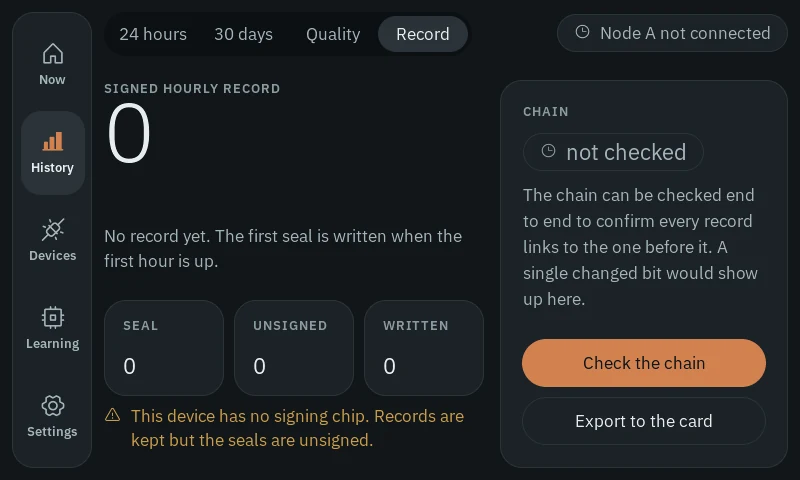
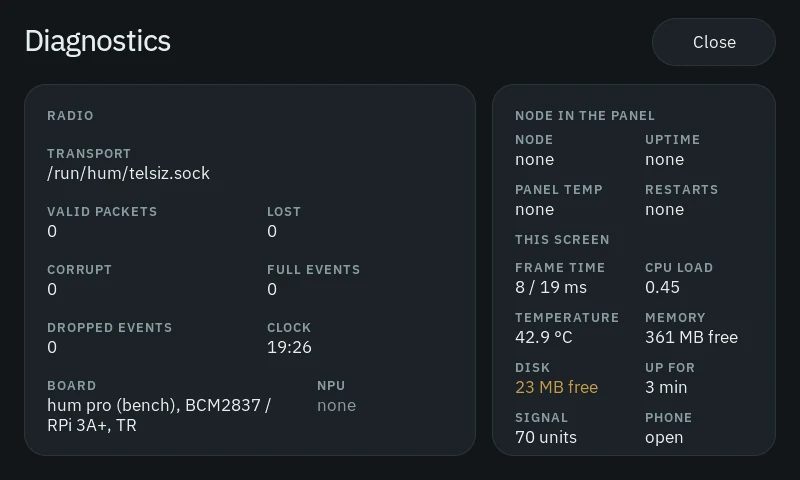
One large number you can see from the sofa, and the detail when you walk up to it. These are the device's own screens, exactly as its software draws them today. The screen speaks English or Turkish; these are in English.
The phone app
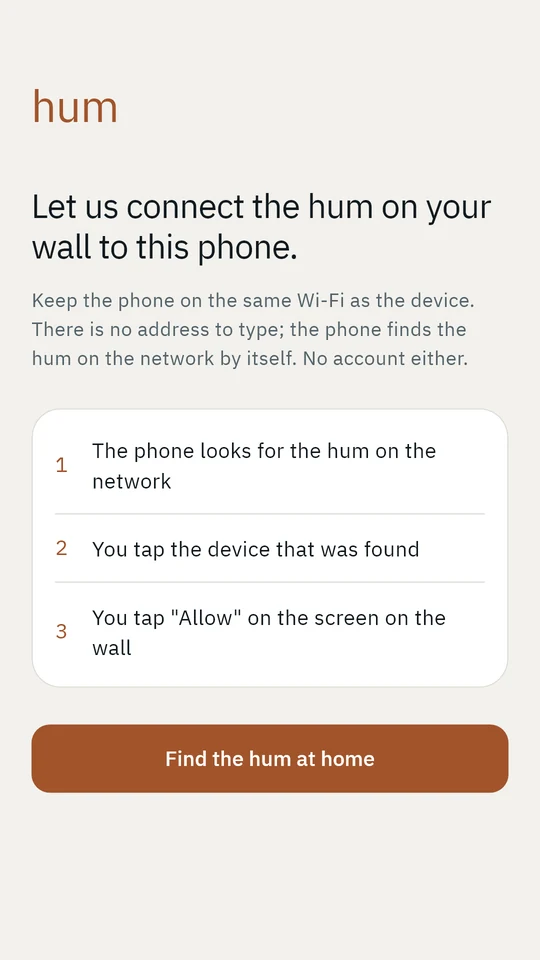
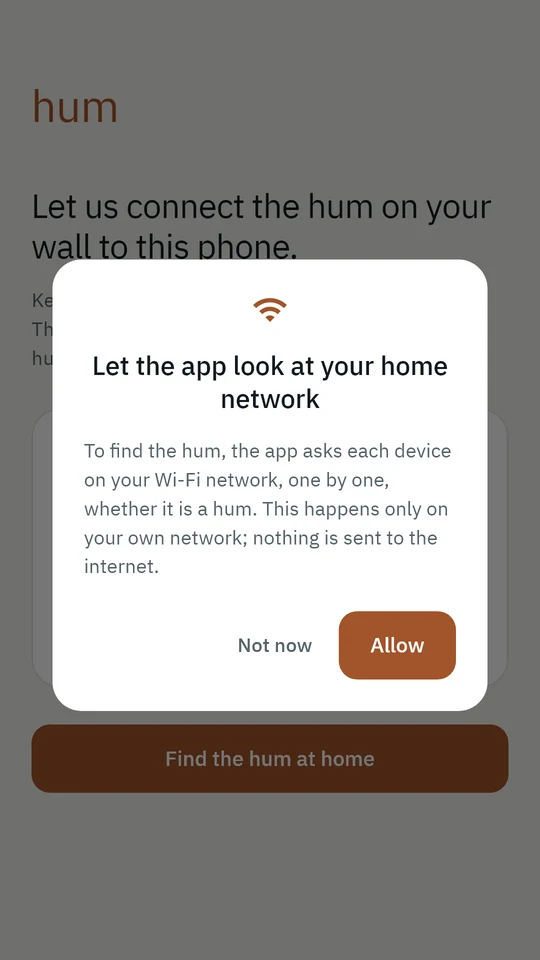
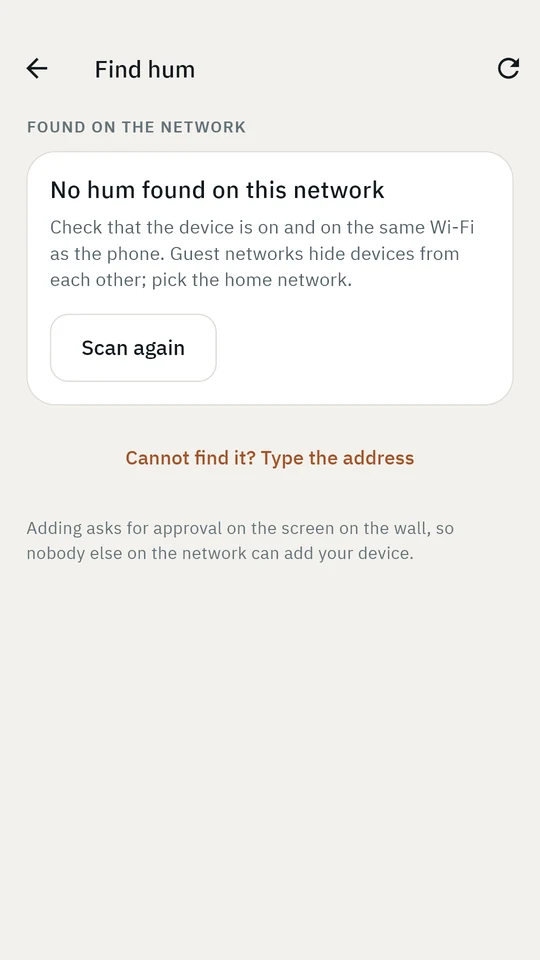
Your phone finds it. The wall says yes.
No address to type and no account. The app looks for hum on your home Wi-Fi by itself, and the hub asks on its own screen before any phone may connect.
Limits
What it can tell you, and what it cannot.
Working out appliances from a single measurement point is a thirty-year research problem with published limits. Here they are, before you buy anything.
| How well | Which things | Why |
|---|---|---|
| Reliably | Water heaters, EV charging, pool pumps | Large, distinctive, and they hold one state for a long time. |
| Usually | Fridges, air conditioning, dryers | A motor starting has a signature, and these cycle predictably. |
| Poorly | Ovens and hobs, boiler fans, washing machines, dishwashers | They change state constantly and overlap with one another. |
| Hardest | Computers, TVs, small electronics | Small, and their draw moves with whatever they happen to be doing. |
Every product in this category struggles with the bottom two rows, including the ones that do not mention it.
Compared with what already exists
Two approaches, and the gap between them.
One kind of product guesses appliances but cannot be sure. The other is exact but only knows circuits. hum names appliances and marks which part of each answer is measured and which part is a guess.
| Whole-house AI | Per-circuit clamps | hum | |
|---|---|---|---|
| Tells you the appliance | yes, eventually | no, only the circuit | yes, and how sure it is |
| How long until it knows | weeks to months | immediate | you name it the first time it appears |
| Unidentified consumption | often large, not shown | none by design | shown as its own line |
| Installation | one or two clamps | up to sixteen clamps | one to three clamps |
| Works without internet | no | partly | fully |
| Subscription | varies | none | none |
| Signed, verifiable record | no | no | yes |
This category is moving. The best-known whole-house AI monitor stopped selling its hardware at the end of 2025 to build into utility smart meters instead; existing owners keep their support. A product that depends on a company's servers is only as permanent as the company's plans. hum keeps working if we disappear.
The record
A reading you can prove you did not change.
Underneath the clever part is the plain part. hum measures, and signs what it measured. Each hour is chained to the one before it, using a key generated inside a chip that will not give it back.
- A disputed bill
- An hour-by-hour account of your own that an independent party can verify was not edited afterwards.
- A shared meter
- What one flat actually used, in a building that is billed as one.
- Solar export
- Your own record of what went back to the grid, next to theirs.
- Charging at home for work
- A defensible figure for the car you charge on your own supply.
- A landlord's meter
- Something to show when someone asks how you know the number is right.
The split is the whole design: the measurement is certain and signed. The appliance names on top of it are probable and marked as such. We never sign a guess.
No cloud and no subscription.
If we disappear, it keeps working.
Your home's electrical behaviour is a record of when you are in, when you sleep, when you cook and what you own. So it stays in the house. What stays where
Specifications
For the curious.
You need none of this to use it. It is here because we would want it if we were buying.
- Measurement
- 24-bit simultaneous sampling on six channels at up to 32 kSPS. Voltage and current are sampled together, so it can report real power and power factor.
- Range
- Full scale around 113 A per channel with the standard clamp, chosen so a motor's starting surge still fits without clipping the signature we want.
- Resolution
- The noise floor sits near a quarter of a watt, roughly a hundred times below the smallest change we try to report.
- Supply types
- Single phase, split phase and three phase from one board. The type is chosen at setup; unused channels stay empty.
- Link
- Sub-GHz radio between the two units. It gets through a metal consumer unit and interior walls far better than 2.4 GHz. The band follows your region.
- Safety
- Nothing on the sensor board is connected to mains voltage. The clamps go around insulated conductors and the voltage reference comes through an isolated plug-in adapter.
- Identity
- A dedicated secure element generates the signing key on-chip. The private key cannot leave the package, and we cannot read it either.
- Hub
- A 4.3-inch touchscreen and on-device storage for the record and the learned appliance templates. hum pro adds a neural processor.
- Power cuts
- The hub has its own battery, so it stays awake when the power goes out, and the outage is written into the record like any other hour.
- Phone
- Finds the hub on your home Wi-Fi without an address, and connects only after the hub approves it on its own screen.
Questions
Before you ask.
Do I need an electrician?
The clamps go around the incoming conductors inside your consumer unit, so the cover has to come off. Nothing is cut or rewired and no part of hum touches a live conductor. Even so: switch the main breaker off first, and if an open panel is not something you are comfortable with, have an electrician clip them on.
Will it recognise my appliances on day one?
On day one it recognises kinds of machine, for example that something with a compressor or a heating element started. It will not know that the compressor is your fridge until you tell it, once.
What happens to the consumption it cannot identify?
It appears as a line called "Not identified", with its own number. It will be large at first and shrink as you name things.
Can someone else on my Wi-Fi connect to it?
Not without you. A phone can see that a hum exists on the network, but it only gets access after someone presses "Allow" on the hub's own screen, which shows the phone's name. If nobody answers within two minutes, the request is dropped.
Does it work with solar?
Yes. Export shows as negative power and is kept apart from consumption, so a kilowatt you sold is never counted as one you bought.
What if your company disappears?
hum keeps working. There is no licence check, no server it phones for permission, and no account. The record stays on the device and stays verifiable, because checking it only needs the device's public key.
Is this a smart meter?
No. Your utility's meter is the one that bills you; hum does not replace it or interfere with it. It measures the same electricity independently and keeps its own record, which helps when the two disagree.
When can I buy one?
There is no date, because we do not have one that would be honest. The hardware is in development. Leave an address below and we will write once, when there is something real to show.
Not built yet.
hum is in development at Veltrix, so nothing ships today and nothing is charged. Reserve one if you want us to build yours in the first run, or just leave an address below and we will write once, when there is something real to show.
One email. Not a newsletter. What we keep